
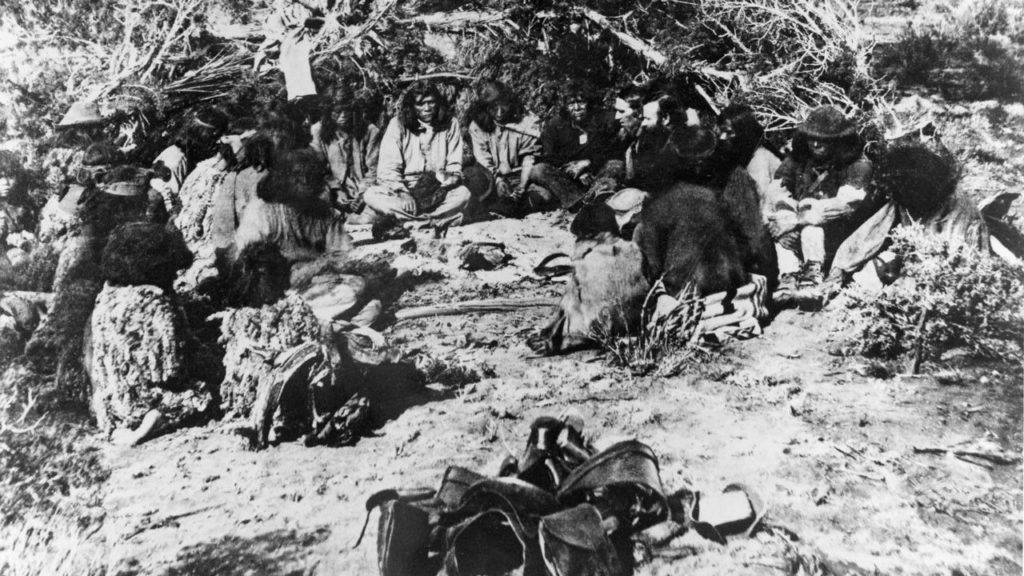
The life of Jacob Hamblin was full of adventure, struggle and near death experiences. He was the man called on, when conflict arose among the Native American Tribes and the Pioneer settlers. Jacob Hamblin was sought to calm the tensions between the two groups, sometimes in the most trying circumstances. He worked tirelessly to bring peace.
Often times Jacob was working with Natives that did not speak English. Jacob learned to speak some of the Native American languages, but he was often relying on the Spirit to communicate with the help of Native translators. Jacob was working with many different Native Americans. tribes, many speaking different languages it was very difficult to communicate. Jacob relied heavily on his Father in Heaven, trusting he would be protected and guided to help the groups to live in peace.
In Jacob Hamblins autobiography he tells the story of an imminent war between the Native Americans and the settlers when three Navajo's were murdered in the Grass Valley. These Navajo boys were killed by white men, but not Latter-day Saints. Jacob was sent to stop the threat of war.
When Jacob heard of the deaths of these Navajo boys, he knew it would be a very delicate and volatile situation. He traveled to a place called Moancoppy where he hoped to find some Navajo to help him discover the temperament of the Navajo people. When Jacob arrived at the area nobody was there to meet him, there was only a Piute family and a Oriba woman. Worried the problems were already escalating Jacob hurried to find the group of Navajo.
While journeying to the Navajo people, Jacob received information that the families of Navajo boys killed were exasperated and ready to fight. The older Navajo men desired first to speak to Jacob Hamblin before any more were hurt.
When Jacob arrived to the Navajo camp, he was not greeted with the same warm greetings he was use to from this group.
Jacob recorded:
"Two or three gray-headed men came out to meet us good naturedly, but did not appear as friendly as they had formerly. I told them of my business. Soon afterwards some young men put in an appearance, whose looks bespoke no good."
Jacob was told the group was not ready to talk, they were waiting for the family of the boys that were killed, and would not begin until the relatives arrived.
Jacob said his spirit was "weighed down with gloomy forebodings and would have left the place could I have justified in doing so. Unless the Lord was with us, what were we to do with all these against us?"
At noon the next day the Navajo said they were ready to talk. All the people involved gathered in a log cabin with only one entrance, Jacob noticed there was no way of escape, if it became necessary. There were twenty-four Navajo gathered in the cabin, four of the men were councilors of the nation.
When the talks began, a relative to the young men who died was upset saying that the Navajo were lied to by Jacob Hamblin. The family said that because these boys went to trade with the "white people" when the boys were killed. One injured with a bullet hole through him.
The angry Navajo relative went on to say, that Jacob would not be able to go home, but would be killed as payment for the deaths of the boys. The Navajo man said the two men who had come to accompany Jacob were allowed to leave and live, but only if they left right away.
Although extremely afraid for their lives, the men chose to stay with Jacob and support him in negotiations.
Tension were very high but Jacob stayed calm through the negotiations reminding the Navajo of his efforts for peace and understanding of each other. Jacob told them that he hoped they would not kill him for a wrong he, nor his people committed. The gray-headed men of the group sided with Jacob, but the younger men were worried they could not have revenge.
The Navajo brought in the young men who survived with bullet holes and showed his wounds to the group. This stirred up the people again to great anger against Jacob. They were upset and ready for revenge. Through the chaos Jacob said the spirit whispered to him of an assurance that all would be okay.
It was hours of negotiations and over time the desire for blood revenge diminished. The Navajo changed the desire to kill Jacob to wanting extreme amounts of payment for the lives of the boys. The Navajo asked to be paid 100 head of cattle for each of the three Navajo killed and fifty for the wounded one. This was more than Jacob would earn the rest of his life, is was a huge amount to pay. Jacob thought of agreeing to the terms and running, and simply worry about fulfilling the terms another day. He knew agreeing to the terms and not paying would never work, but he really wanted to be out of the life threatening situation.
Ultimately, Jacob chose to continue to work on an agreement and told the men he would not sign the agreement that was unreachable, because he would never be able to pay. Jacob said that he had never lied to them and he would not pay for the wrong that other people had done.
The group sat in negotiations for 12 hours before it was over. Jacob reiterated that it was not his men who had killed those boys and the Navajo are still free to trade without fear from his people. Simply trying to defuse the strong feelings of the night.
After many hours on intense negotiations the Natives finally agreed to let Jacob leave with his life! They also agreed to start no war over the deaths of these boys. Jacob and his companions were relieved beyond words.
Years before Jacob had been given a promise saying "if I would not thirst for the blood of the Lamanites, I should never die by their hands."
Jacob Hamblin's life was protected once again by the grace of God. The negotiation that night was one of the most intense and terrifying experiences of the life of Jacob Hamblin. Multiple times through negotiations the Natives wished to kill Jacob and have it be over. The Spirit of God helped calm the heightened emotions of the Navajo, desiring revenge for the loss of the young boys who had been killed. Jacob calmly reminded the Navajo people of their desires to work together and be able to live amongst each other. Jacob had worked with the Native people for years, and was very close friends with many of them. Jacob was able to stand straight and tall, knowing he had the protection of God. He was able to be a peace maker between the two groups, protected and helped by God.
In the talk "Bible Stories and Personal Protection" by President Dallin H. Oaks given in October 1992 he spoke about stories from the scriptures of the protection from God.
He said:
Another favorite example of God’s protecting care is the shepherd boy David. David had a firm faith in the God of Israel, and that faith gave him great courage.
When the armies of the Philistines were gathered to battle against the Israelites, the mighty Goliath came forward and hurled his challenge to individual combat. King Saul and all Israel “were dismayed, and greatly afraid” (1 Sam. 17:11). Day after day he renewed his challenge, but no one would face him.
When young David came to the camp of Israel to deliver provisions, he heard Goliath’s roar. In surprise David asked, “Who is this uncircumcised Philistine, that he should defy the armies of the living God?” (1 Sam. 17:26). David asked if he could fight the man. The king refused, saying, “Thou art but a youth” (1 Sam. 17:33). David replied with courage and faith: “The Lord that delivered me out of the paw of the lion, … he will deliver me out of the hand of this Philistine” (1 Sam. 17:37).
As David went onto the field of battle, Goliath mocked him for his youth, cursed him by his gods, and shouted that he would feed his flesh to the birds and beasts of the field (see 1 Sam. 17:42–44).
David’s reply is one of the great expressions of faith and courage in all our literature. It thrilled me as a boy, and it still thrills me.
“Thou comest to me with a sword, and with a spear, and with a shield: but I come to thee in the name of the Lord of hosts, the God of the armies of Israel, whom thou hast defied.
“This day will the Lord deliver thee into mine hand; and I will smite thee, and take thine head from thee; and I will give the carcases of the host of the Philistines this day unto the fowls of the air, and to the wild beasts of the earth; that all the earth may know that there is a God in Israel.
“And all this assembly shall know that the Lord saveth not with sword and spear: for the battle is the Lord’s, and he will give you into our hands” (1 Sam. 17:45–47).
You all know what happened next. David stunned the Philistine with a sling-stone and cut off his head with his own sword. Frightened by the fall of their champion, the Philistines fled. Shouting in triumph, the armies of Israel pursued them and won a great victory.
Countless young people have been inspired by this marvelous instruction in righteousness. At times all of us must stand against those who mock and revile. Some of us, sometime, will face some earthly power as mighty as Goliath. When that happens, we should emulate the courage of David, who was mighty because he had faith and he went forth in a righteous cause in the name of the Lord of Hosts.
I am grateful that the Lord gave me the vision and strength to refrain from trusting in the arm of flesh and to put my trust in the protecting care of our Heavenly Father. I am grateful for the Book of Mormon promise to us of the last days that “the righteous need not fear,” for the Lord “will preserve the righteous by his power” (1 Ne. 22:17). I am grateful for the protection promised to those who have kept their covenants and qualified for the blessings promised in sacred places.
These and all promises to the faithful children of God are made by the voice and power of the Lord God of Israel. I testify of that God, our Savior Jesus Christ, whose resurrection and atonement have assured immortality and provided the opportunity and direction toward eternal life. In the name of Jesus Christ, amen."
References:
Jacob Hamblin: A Narrative of His Personal Experience as a Frontiersman, Missionary to the Indians and Explorer : Disclosing Interpositions of ... Perilous Situations and Remarkable Escapes p 114-125